
Taking Elderly Parents for Umrah: An Honest Planning Guide
Taking a parent for Umrah is, for a lot of families, the whole reason they book. It is also the version of the trip that most often goes wrong, and it goes wrong in ways that are entirely predictable a month beforehand. Almost none of it is about fitness. It is about distance, heat, timing and rest, and every one of those is a decision you make before you leave.
Key takeaways
- Distance to the Haram decides more than anything else. For an older pilgrim it is the difference between five prayers a day and two.
- Wheelchairs are available in both Harams, and the upper levels of the mataf are made for them. Using one is not giving up.
- Month matters as much as money. October to February is kind. Summer is not.
- Build rest into the itinerary rather than hoping for it. The second and third days are where fatigue arrives.
- Bring medication in hand luggage, in its original packaging, with a copy of the prescription.
- Decide in advance who is responsible for what. Two people sharing the care of one parent works far better than four people assuming.
Be honest about the walking before you book anything
The question is not whether your parent can walk. It is whether they can walk far enough, five times a day, in heat, for a week, and still have anything left. Those are very different questions and families routinely answer the first one when they should be answering the second.
A useful test at home: can they walk for fifteen minutes, rest, and do it again four more times in a day? If the answer is no, that is not a reason to cancel. It is a reason to plan differently, and the rest of this guide is about how.
The single most useful thing you can do
Ask them directly what they are worried about. Most older pilgrims have a specific fear, usually about being a burden or about needing the toilet, and almost none of them raise it unprompted. It is far easier to solve a month early than on the second morning.
Hotel distance is the whole trip
In Makkah, every minute between the hotel door and the Haram is paid five times a day, and paid again on the way back. A ten minute walk is not ten minutes. It is a hundred minutes of walking a day for someone who may already be at their limit after the first one.
This is why we put older pilgrims in the hotels closest to both Harams rather than the cheapest ones. Not because it is a nicer trip, though it is, but because it changes what is physically possible.
- Swissotel Makkah, Clock Tower: Facing the Haram. The shortest walk we can offer in Makkah.
- Rotana Jabal Omar Makkah: Under 2 minutes' walk. Close enough that going back for every prayer stays realistic.
- Anwar Al Madinah Mövenpick: Facing Masjid an-Nabawi, in Madinah, and on the ladies' side.
- Pullman Zamzam Madinah: Under 1 minute's walk from Masjid an-Nabawi.
Where the shuttle stops being a saving
A shuttle hotel is a sensible trade for most travellers. For an older pilgrim it usually is not. It adds a wait at both ends, it runs to a timetable rather than to how they feel, and the practical result is that they stop going back for every prayer. The money saved buys a trip they experience less of.
Wheelchairs, and getting past the reluctance
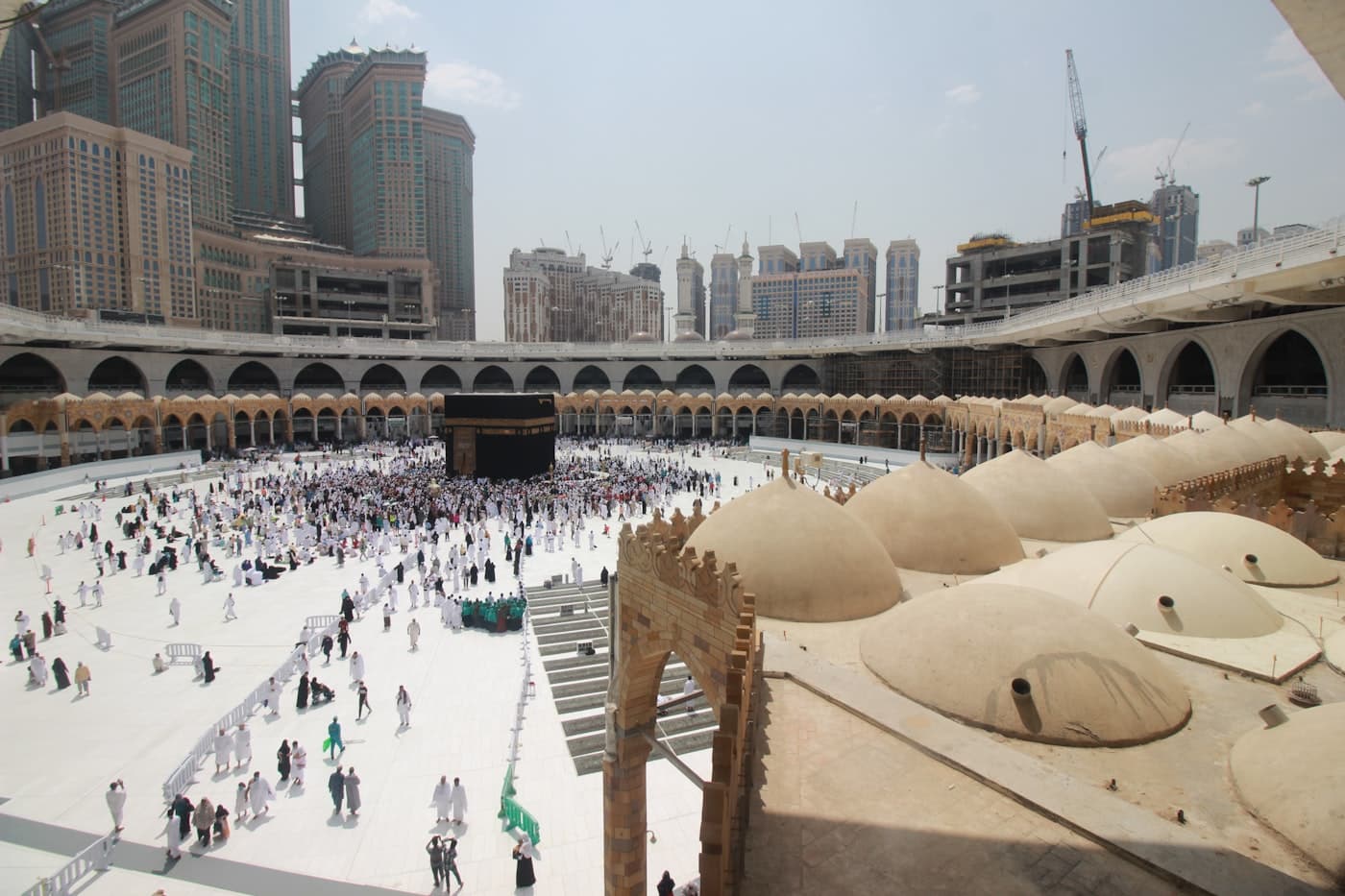
Wheelchairs are available at both Harams, and there are routes and levels specifically for them. The mataf has upper levels reachable by ramp and lift, and doing tawaf on an upper level is valid, unhurried, and enormously easier than the ground floor in a crowd.
The obstacle is almost never availability. It is that a parent does not want one. This is worth handling with some care, because the framing matters: a wheelchair is not a verdict on their health, it is the thing that lets them stay in the Haram for an hour instead of twenty minutes. Many families find the easiest route is to hire one for the tawaf specifically, rather than for the whole trip, so it is a tool for a task rather than a label.
- Both Harams have wheelchairs, and there are attendants who push for a fee if nobody in your party can.
- The upper levels of the mataf are far less crowded and are designed for wheeled access.
- Bring your own lightweight chair if they already use one and it fits your baggage allowance.
- Agree beforehand who is pushing. It is more tiring than people expect, and it should rotate.
Pick the month with as much care as the hotel
Weather is not a comfort question for an older pilgrim, it is a capability question. Heat is what turns a manageable walk into an impossible one, and Saudi summers are genuinely dangerous for people with heart or breathing conditions.
The kind months are roughly October through February. Our own monthly departures reflect it: October is the one we most often suggest for older pilgrims, because the walk to all five prayers stays comfortable and the winter crowds have not arrived.
- October and November: mild, and the best balance of weather against crowds.
- December and January: coolest of the year, though evenings turn genuinely cold and Madinah more so than Makkah.
- Ramadan: spiritually the peak and physically the hardest. Fasting, crowds and long nights together.
- June through September: avoid unless there is no choice.
About Ramadan specifically
Plenty of older pilgrims manage Ramadan and are glad they did. The first half is calmer than the last ten nights by a wide margin, and if Ramadan is the reason for the trip, that is the half to pick. Be honest with yourself about whether the fasting, the crowds and the late nights are survivable together rather than one at a time.
The journey itself, which people forget to plan
A long flight from the US, then immigration, then a transfer, then a hotel check-in, is a full day of exertion before any worship happens. Families plan the Umrah in detail and treat the travel as something that simply occurs.
The most common mistake we see is a first tawaf attempted on the day of arrival, because everyone is eager and nobody wants to say they are tired. It rarely goes well, and it costs the next two days.
- 1
Choose the routing for tiredness, not price
A direct flight or a single short connection is worth real money here. A cheap ticket with two connections and a long layover arrives with a person who cannot do anything for a day.
- 2
Ask for airport assistance when booking, not at check-in
Every airline provides it free and it must be requested in advance. It covers the long walks between gates and immigration, which are the parts that exhaust people most.
- 3
Plan to rest on arrival day
Check in, eat, sleep. Go to the Haram for one prayer if they want to, without ihram and without tawaf. Start the Umrah the following morning.
- 4
Do the first tawaf at the quietest hour you can
Mid-morning after Fajr, or late at night, are both far calmer than after any of the busy prayers. Ask your guide which will be quietest on that specific day.
Medication, health and paperwork
None of this is complicated, and all of it is miserable to sort out after the fact in a country where you do not speak the language.
- Medication goes in hand luggage, in original packaging, with a printed copy of the prescription.
- Bring more than the trip needs, in case of a delay.
- Carry a short written list of conditions, medicines and allergies, in English and ideally in Arabic.
- Check the medical insurance included with the Umrah visa, and consider a separate policy if there are existing conditions.
- If anyone uses a CPAP machine or similar, tell the airline and confirm the hotel has a suitable socket.
Worth a conversation with their doctor
Anyone with a heart condition, a breathing condition, or reduced mobility should speak to their own doctor before booking, not after. We are a travel agency and not a medical service, and there are trips we would rather talk somebody out of than sell.
Rawdah, and being realistic about it
The Rawdah matters enormously to most older pilgrims, and it is the part of the trip most likely to disappoint if it is left to chance. It needs a free permit booked through the Nusuk app, slots go quickly, and the walk inside Masjid an-Nabawi to the right entrance is longer than families expect.
Book the permit for a day that is not the arrival day and not the departure day, go with them, and have the permit on your own phone as well as theirs.
The full detail is in its own guide
How the permit works, what to do when the app shows nothing, and what happens at the entrance are all covered in our guide to booking the Rawdah. It is worth reading before you travel rather than in the hotel lobby.
Decide who does what before you go
In a family group, care for an older parent tends to be everybody's job and therefore nobody's. It is worth ten minutes and an actual conversation.
Name one person responsible for medication, one for the wheelchair, and one who stays with them if the group splits up. Agree that anybody may call a stop without it being a discussion. On the days when it matters, that agreement is the difference between a rest and an argument.
Frequently asked questions
Age on its own is rarely the deciding factor. Mobility, heat tolerance and stamina are, and all three can be planned around with the right hotel, the right month and a wheelchair where it helps. We have taken pilgrims in their eighties who managed comfortably, and we have advised against trips for people twenty years younger. If you are unsure, tell us honestly what they can and cannot do and we will tell you honestly what we think.
Yes. Tawaf in a wheelchair is valid, and the upper levels of the mataf are designed for it, with ramps and lifts. Those levels are also considerably less crowded than the ground floor, so it is often the calmer experience as well as the easier one. You can push them yourself or hire an attendant at the Haram.
October and November are the ones we suggest most often. The summer heat has broken, the walk to the Haram is comfortable, and the winter holiday crowds and prices have not arrived. December and January are cooler still and also good, as long as you pack a warm layer for Fajr, which catches families out every year.
Yes, and the most useful thing we do is at the planning stage rather than on the ground: putting them in a hotel close enough to the Haram that the walk stops being the deciding factor. Beyond that our guides know which entrances have the shortest walks and which hours are quietest, and our coordinators help with the Nusuk app in person. Tell us at the enquiry stage that you are travelling with an older parent and we will build the itinerary around that rather than adding it afterwards.
The rites can be paced across more than one day, and there is no requirement to do everything in a single exhausting session. Tawaf, then rest properly, then sa'i later or the next morning, is completely acceptable and it is what we suggest more often than families expect. Tell your guide early rather than pushing on. Almost every problem we have seen came from somebody not wanting to say they needed to stop.
Ready to plan your journey?
Tell us your dates and a US-based Umrah & Hajj specialist will put a free quote together for you. No obligation.